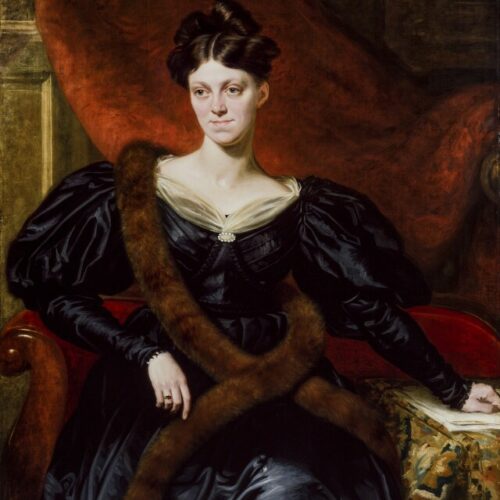
What an emancipation it is, — to have escaped from the little enclosure of dogma, and to stand, — far indeed from being wise, — but free to learn!
Harriet Martineau, Letters on the Laws of Man’s Nature and Development (1851)
Norwich has a rich radical tradition, and across the centuries has been home to many freethinkers, activists, and humanists who have championed reason, rights, and human happiness.
This page accompanies our printable Norwich walk, with more about each stop and links to everyone and everything mentioned along the way.
Charles Bradlaugh, the ‘first atheist MP’ and founder of the National Secular Society, spoke here at St Andrew’s Hall, having earlier been prevented from doing so. The hall was regularly sought by, but not always granted to, radicals and activists throughout the 19th century. Norwich rallied in support of Bradlaugh when he was refused his seat in Parliament because, as a professed atheist, he could not swear the oath. Jacob Henry Tillett MP, a nonconformist, supported Bradlaugh’s efforts to affirm rather than swear. After seven years, he was finally able to affirm.
This thread of practical, earthly change, wielded by human beings without supernatural influence, runs throughout the story of Norwich freethinkers.
Find out more: The Right to Affirm: Freethinkers and the Oaths Act 1888
St George’s Street, historically known as Gildenegate and later Middle Street, was transformed in 1898 when the Corporation merged it with Bridge Street to create the continuous thoroughfare seen today. In the 19th century it was home to Lot Hill (1815–1894), a radical bookseller and secularist. In 1867, after the death of Daniel Weavers, a hand-loom weaver and Owenite from nearby Rose Yard, St Augustine’s, Hill organised a collection to support Weavers’ family.
The Octagon Chapel was completed in 1756 by the architect Thomas Ivory (also responsible for the Assembly House), and today is home to an inclusive community of Unitarians who welcome people of all faiths and none. Rooted in dissent from the Anglican Church, Unitarianism emphasises individual conscience and progressive thought.
One influential Unitarian, religiously, politically, and in his influence on the development of humanism, was William Johnson Fox (1786–1864): politician, journalist, and leader of South Place Chapel in London (now Conway Hall). Fox was born in Suffolk but raised in Norwich, where he worked as a weaver and in a bank. Among other causes, he advocated divorce on the grounds of mutual incompatibility, and defended freedom of speech, notably taking a stand for Richard Carlile, imprisoned for years for selling works (like those of Thomas Paine) deemed blasphemous or seditious. Through his magazine, Fox also encouraged the early careers of Tennyson, Browning, and Norwich’s own Harriet Martineau.
Find out more: South Place Ethical Society
In 1767 a young William Godwin arrived in Norwich, where he was tutored by Samuel Newton at the Old Meeting House. Godwin did not enjoy the experience, bemoaning ‘the odiousness of Norwichers’, calling Newton ‘the most wretched of pedants’, and Newton’s wife ‘an animated statue of ice’.
Godwin went on to become one of the most famous English writers of the revolutionary period and a leading radical spokesman. Despite being ideologically opposed to marriage, in 1797 he married the feminist writer Mary Wollstonecraft, then pregnant with their daughter, the future Mary Shelley, author of Frankenstein.
En route to the next stop, you’ll travel down Golden Dog Lane: another home, during the 1870s, of the radical bookseller and secularist Lot Hill.
Gurney Court was the birthplace of Harriet Martineau: sociologist, writer, and freethinker. Born in Norwich to a Unitarian family, she ultimately rejected all religion, which she described in liberating terms.
Her brother James (1805–1900), by contrast, remained a staunch Unitarian and became an influential preacher. The two were extremely close in their younger years, but 1851 saw the end of this. Early that year, Harriet and her friend Henry George Atkinson published Letters on the Laws of Man’s Nature and Development, in which she wrote: ‘What an emancipation it is, — to have escaped from the little enclosure of dogma, and to stand, — far indeed from being wise, — but free to learn!’ James savaged the book for what he saw as its promotion of atheism. This destroyed their relationship: although they occasionally met, they never again corresponded.
A fervent abolitionist and pioneering sociologist, Martineau was also responsible for the 1853 translation of Auguste Comte’s positive philosophy, popularising his secular ‘religion’ in England. Among those directly influenced was George Eliot.
Find out more: Positivism · Martineau’s grave at Key Hill Cemetery, Birmingham
Sampson Arnold Mackey (1765–1843) was a shoemaker, autodidact, and cosmologist, known as ‘the self-taught astronomer of Norwich’, who was buried in the parish of St Saviour’s. Born in Norwich and apprenticed to a shoemaker aged eleven, he also studied astronomy, geology, and mythology, writing original works and giving lectures. During the 1830s Mackey was a regular visitor to London, where he was the guest of the radicals Richard Carlile and James Watson, and lectured at radical halls and chapels.
Based on his ideas about the axial tilt of the Earth, Mackey challenged Christian narratives of the history and age of our planet, arguing that his own theories sought to clear away ‘the obstructive rubbish’ and ‘leave the road open’ for those who pursued real knowledge.
Duke Street was home from the mid-1880s to the Gordon Hall and Cafe: a centre for the city’s socialist movement.
Born Frederick Charles Slaughter, Fred Charles was a leading light of the very active Norwich branch of the Socialist League in the 1880s. When the League published its Manifesto in 1885, Norwich socialists enthusiastically set up a branch, with Fred instrumental. He went on to found and run a café as a centre for the movement: the Gordon Cafe at 5 Duke Street, close to the Free Library on the corner of St Andrew’s and Charing Cross. Charles was known for his unflinching generosity. His friend David Nicoll, editor of the League’s paper Commonweal, remarked: ‘I, who knew him well, have often thought that Charles, Atheist and Anarchist as he was, had more of the spirit of Christ about him than those who talk so loudly of their Christianity’.
Another Fred, James Frederick ‘Fred’ Henderson (1867–1957), was a socialist, Fabian, and Lord Mayor of Norwich in 1939–40. His most famous work, The Case for Socialism, grew out of sermons delivered at the Norwich Labour Church. Labour Churches sought to imbue Christianity with practical reform and workers’ rights, appealing to those ‘who believe in a practical religion and despise a faith that does not lead to action’. Despite its religious leaning, the Labour Church movement had much in common with the ethical movement, and a number of Labour Churches were affiliated to the Union of Ethical Societies (now Humanists UK). The Norwich Labour Church and Ethical Society (1910–1912) met at the Victoria Rooms on St Stephen’s.
Find out more: William Morris, founder of the Socialist League
Take the walk: download the printable Norwich walk (PDF), or see all of our walking tours.
To all those who have established and who are maintaining the right to refuse to kill. Their foresight and courage […]
I had long put on one side the purist pacifist view that one should have nothing to do with a […]
Rational Humanism is an ethical outlook, which seeks to be in accord with a scientific survey of man’s world. It […]
A brief history of humanism and secularism in Northern Ireland Organised humanism began in Northern Ireland in the 19th century, […]