Bloomsbury has been home to dozens of individuals and organisations who helped to shape the modern humanist movement, and who profoundly changed the world around them. Beginning at historic Conway Hall, this walk introduces a range of freethinkers, activists, creatives, and community leaders who thought for themselves and acted for everyone.
This page accompanies the printable Bloomsbury walk. You can also explore nearby Red Lion Square, where the walk’s themes come together.
Conway Hall opened in 1929, named for the Virginia-born Moncure Conway (1832–1907), an abolitionist and freethinker.
Conway had been the ‘minister’ of the hall’s predecessor, South Place Chapel in Finsbury. What began as a dissenting congregation in the 1700s (rejecting the doctrine of eternal damnation) moved over the following centuries through Unitarianism to an ever more humanist outlook. This culminated in 1888 in the appointment of the American-born Ethical Culture leader Stanton Coit (1857–1944), under whose leadership it moved officially from a ‘Religious’ to an ‘Ethical’ Society: the South Place Ethical Society. Ethical societies emphasised ‘deed without creed’, living well without reference to any notions of reward or punishment in the hereafter. They were the forerunners of today’s humanist groups.
Today, Conway Hall is a vibrant cultural venue and home to the Humanist Library.
Find out more: Conway Hall · Barralet v Attorney-General (1980) · Portrait of Ellen Dana Conway
20 Rugby Street (formerly 19 Chapel Street) was the site of the positivist Church of Humanity, established by the philosopher Richard Congreve (1818–1899) in 1870. Rooted in the ideas of the French philosopher Auguste Comte, positivism sought to celebrate the achievements of humankind through secular ritual. The freethinker Harriet Martineau (1802–1876) had played a significant role in popularising Comte’s ideas with her 1853 translation of his Cours de philosophie positive.
Not everyone liked the idea of congregation-style humanism, but many found much to admire in positivism. Among them was the pioneering humanist and teacher F. J. Gould (1855–1938), who wrote in his Life Story of a Humanist:
No creative thinker has so governed… my mind as the French genius who framed the maxim — ‘Love for principle, and Order for basis; Progress for aim.’
F. J. Gould, Life Story of a Humanist (1923)
Brunswick Square has an all-star cast of former residents, including Leonard and Virginia Woolf, John Maynard Keynes, and E. M. Forster, all of whom were humanists. Virginia lived with her brother Adrian, Leonard, and Keynes at no. 38 in 1911–12.
Woolf believed in neither god nor afterlife, writing instead: ‘I cling to my tiny philosophy: to hug the present moment.’ Like her Mrs Dalloway (from the novel of 1925), hers was an ‘atheist’s religion of doing good for the sake of goodness.’
Fellow writer E. M. Forster was active in the humanist movement and in the cause of civil liberties. A humanist, wrote Forster, had ‘four leading characteristics — curiosity, a free mind, belief in good taste, and belief in the human race.’ He lived at 26 Brunswick Square from 1930 to 1939.
Find out more: Portrait of E. M. Forster at Conway Hall
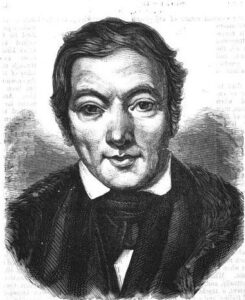
Welsh-born Robert Owen (1771–1858) was a utopian socialist, philanthropist, and reformer, whose time living here covered some of the busiest years of the Owenite movement. Owen was sceptical of organised religion, and motivated by the belief that human character was shaped by circumstance, not inbuilt from birth. As a mill owner he introduced pioneering changes to education, community, and labour, and later applied these lessons to experimental communities in Britain and abroad. Of his hopes for grand social reform, he wrote:
My plans were all laid to gradually supersede these religions… by the practical religion of love and charity for our race, irrespective of colour, country, class, sect, sex, party, or difference in natural organisation or constitution; and thus to attain happiness, the great object of humanity.
Owen’s ideas influenced many others, including freethinkers and cooperators during his lifetime and after his death, who were inspired by his humanist approach to life and social reform.
Find out more: Robert Owen Museum, Newtown · Owen’s memorial at Kensal Green Cemetery
A plaque on Woburn Walk remembers George Jacob Holyoake (1817–1906), a writer, lecturer, and promoter of the cooperative movement, who lived here from 1850 to 1861 and who coined the term ‘secularist’ in 1851. For Holyoake, secularism described ‘that province of human duty which belongs to this life’, and work undertaken to improve the lot of humanity. In its focus on living well in this life, without hope of another, Holyoake’s original definition of a secularist is almost identical to that of a humanist today.
Holyoake lived here at the same time as Charles Dickens was living at Tavistock Place, and his home overlooked Dickens’ gardens. In his memoir, Holyoake recalled:
Dickens would have a friend or two in the garden, and a tray of bottled stout, ‘churchwardens’ [pipes] and tobacco would be brought from the house. We were told that this was Dickens’s protest against the doleful way of keeping Sunday then thought becoming.
Find out more: Secularism · Holyoake’s arrest warrant (1842)
In Tavistock Square sits the Conscientious Objectors’ Commemorative Stone, a 400-million-year-old piece of volcanic slate placed in memory of all those who have refused to fight. It was the work of a group of humanists and pacifists, and is dedicated ‘To all those who have established and who are maintaining the right to refuse to kill’.
The campaign was led by Edna Mathieson, whose uncle Joe Brett had been a conscientious objector, and whose enduring philosophy Mathieson described as that of Thomas Paine: ‘my country is the world, and my religion is to do good.’ The stone, sourced in Cumbria, was unveiled on 15 May 1994 by the humanist composer, former conscientious objector, and then President of the Peace Pledge Union, Sir Michael Tippett.
Philosopher, mathematician, and humanist Bertrand Russell (1872–1970) lived here, at flat 34, from 1911 to 1916. A public intellectual, Russell was also a lifelong activist, particularly in the cause of peace and international cooperation. He described the good life as ‘one inspired by love and guided by knowledge’, elaborating:
To live a good life in the fullest sense a man must have a good education, friends, love, children (if he desires them), a sufficient income to keep him from want and grave anxiety, good health, and work which is not uninteresting. All these things, in varying degrees, depend upon the community, and are helped or hindered by political events. The good life must be lived in a good society, and is not fully possible otherwise.
Find out more: What I Believe at 100 · Russell’s teapot
One area of activism in which many humanists were involved was the fight for women’s suffrage. On the corner of Bury Place and Barter Street stood the London headquarters (1914–1959) of the Women’s Freedom League, founded in 1907 by dissenters from the Pankhurst-led Women’s Social and Political Union (WSPU). Among its founding members were Teresa Billington-Greig (1876–1964), a lifelong agnostic and ethical society member, and Lillie Boileau (1869–1930), a key figure in the 20th-century humanist movement.
Even after the Equal Franchise Act of 1928 gave equal voting rights to women and men, the League kept campaigning. In July 1928 its newspaper, The Vote, stated the case:
To have won equal voting rights for women and men is a great victory, but it will be an infinitely greater achievement when we have succeeded in abolishing for ever the ‘woman’s sphere’, ‘woman’s work’, and a ‘woman’s wage’, and have decided that the whole wide world and all its opportunities is just as much the sphere of women, as of men.
The Vote, July 1928
Find out more: Flag of the Women’s Freedom League · Heroines of Freethought
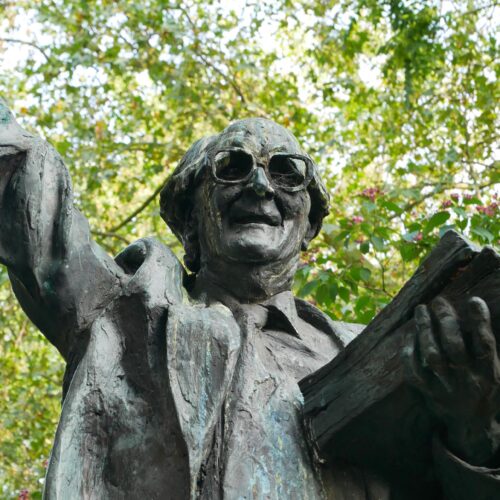
Red Lion Square contains statues of two prominent humanists and pacifists: Fenner Brockway and Bertrand Russell.
A lifelong socialist, anti-racist, and peace campaigner, Fenner Brockway (1888–1988) founded the No Conscription Fellowship in 1914 (at the suggestion of his wife, Lilla) to resist compulsory military service. Alongside Russell he was a founding member of the Campaign for Nuclear Disarmament in 1957 and, aged nearly 90, co-founded the World Disarmament Campaign in 1979. He was a member of the Advisory Council of Humanists UK. Behind all of this lay a love of, and loyalty to, his fellow human beings. He wrote:
My loyalties were not to a country, but to the dispossessed of all countries who were denied real life in peace and summoned to die in war for the very system of which they were the victims.
This bust of Bertrand Russell by Marcelle Quinton was unveiled on 29 October 1980 by Dora Russell, in a ceremony presided over by Lord Fenner Brockway. Dora Russell (1894–1986), herself a prominent humanist and activist, and Bertrand’s wife from 1921 to 1935, had proposed the memorial a year earlier. She was joined in the appeal by Brockway, the philosopher A. J. Ayer, the writers Ritchie Calder and Ted Willis, and the sociologist Barbara Wootton: all leading humanist activists.
Peter Cadogan, then General Secretary of Conway Hall, read from an article Russell had written in 1916:
Our minds and thoughts must not be filled with the evils of this present moment, but with the vision of the world we hope for — a world without violence and bloodshed, where men are free to grow, where the dominion of greed is at an end and love finds no obstacles of mutual selfishness. If we resist, it is… for the sake of the world — because we see how the world might be immeasurably better than it is, because all that is necessary is that others should see too, and because we desire to share with all the hope for the world which makes for our happiness and our opportunity.
Find out more: Red Lion Square · Joseph Rotblat on Bertrand Russell
Take the walk: download the printable Bloomsbury walk (PDF), or see all of our walks.
All religious theories, schemes and systems, which embrace notions of cosmogony, or which otherwise reach into the domain of science, […]
He was dedicated to the cause of secularism, but in his own gentle way he did not neglect to enjoy […]
Robert Owen was a utopian socialist, philanthropist, and reformer, whose own religious scepticism fostered his desire for a secular society, […]
The one thing in which I am interested wholly and completely is the getting to know something about human society […]
